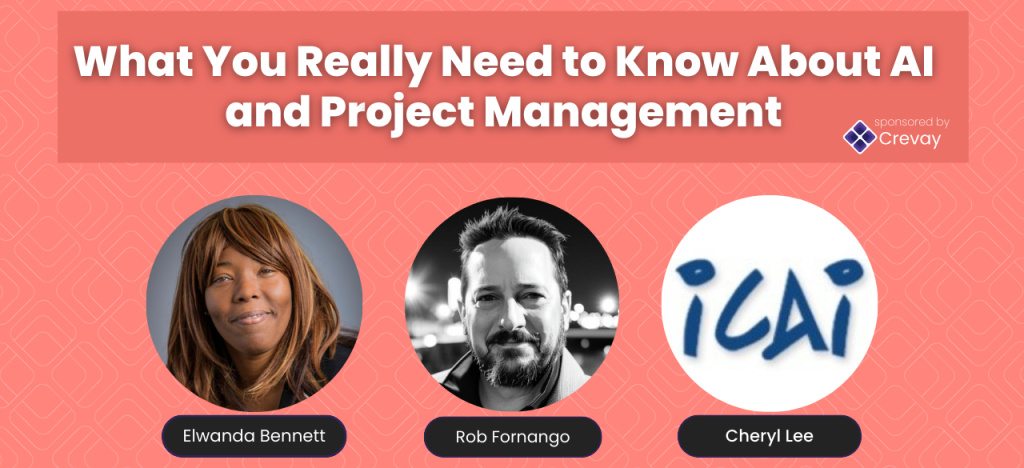
What You Really Need to Know About AI and Project Management

When it comes to integrating AI into project work, there’s no shortage of noise. Product launches, bold predictions, sweeping claims about automation. What’s harder to find is grounded, practical guidance that speaks directly to how project leaders should think about AI right now. 

That’s exactly what we got from a recent Radical Projects Collective panel featuring three standout experts: Cheryl LeeDr. Elwanda Bennett, and Dr. Robert Fornango. Each brought a different perspective, but all agreed on one thing: AI can be a powerful asset for project work, but only if we approach it with purpose, clarity, and a healthy respect for the people it’s meant to support. 

Here are some of the most useful insights from their conversation and how you can apply them to your own work.

Start with Purpose, Not Tools

One of the most common traps we see is project teams starting with the tool. Someone hears about a new app or AI feature, and the first question becomes, “Can we use this?” But as Rob emphasized, that’s the wrong place to begin.

“It’s not about using AI for the sake of it,” he said. “It’s about understanding the problem you’re solving, and only then asking, ‘Can AI help here?’”

Before testing or piloting anything new, ask what capability you're trying to build. Is it faster decision-making? Better visibility? A smarter way to flag risks? AI can support any of these, but only after the purpose is clear.

AI Should Support, Not Replace, Human Judgment

There’s a lot of concern about AI taking over decision-making, especially in project environments that are already overloaded and complex. Cheryl reframed that conversation entirely.

“Even if the AI can make a recommendation, I still want to verify, especially when people are involved.”

The most valuable use of AI right now is as a thinking partner. Let it summarize inputs, highlight trends, and offer suggestions. But don’t hand over the final call, especially when the stakes involve ethics, strategy, or human dynamics.

Start Small and Repeatable

One of the smartest ways to introduce AI is by starting with repeatable, low-risk activities. Think meeting summaries, risk alerts, scheduling.

Elwanda put it this way: “A lot of early AI use in projects is in summarizing conversations, surfacing risks, or helping with prioritization.”

These tasks don’t require a full overhaul of your workflow. They simply replace or enhance small pieces of the puzzle, creating space for your team to focus on more complex, human-driven work.

AI Literacy Is a Team Skill

Another challenge that slows progress is the assumption that project managers will figure it out while the rest of the team stays in the dark.

To get traction, everyone needs at least a basic understanding of what AI can and can’t do. Micro-trainings, internal demos, and opt-in experiments are all good ways to build this skill across the project team.

Transparency Builds Trust

Trust is currency on any project. And when you introduce AI into the mix, disclosure matters.

“If I’m using AI to create project materials, I always disclose that,” Cheryl shared. “Transparency builds trust.”

Whether it’s client-facing content, status updates, or team decisions, flag when AI is part of the process. Normalize its role, but don’t hide it.

Plan for Cultural Resistance

Not everyone is excited about AI, and that’s not a problem. It’s a signal. When project teams resist, they’re often protecting trust, competence, or job security.

Elwanda captured this with real clarity: “People don’t want to look stupid in front of an AI. Or worse, be replaced by one.”

If you want adoption, start with pilot groups. Give people a chance to experiment privately before expecting full buy-in. Make it clear that AI is here to help, not replace.

Let AI Surface What’s Missing

Some of the most valuable use cases aren’t about outputs at all. They’re about patterns. What’s missing, what’s misaligned, what’s unclear.

One speaker noted that they find more value in how AI can help identify gaps, miscommunication, or risks that haven’t yet been named.

AI can analyze unstructured data in ways humans can’t. It can flag friction, confusion, or silent risks. That’s a game changer for project foresight.

Don’t Wait for Perfection

“People are paralyzed by perfection,” said Rob. “Just start. Use what’s in your stack. Try a use case. Learn.”

There’s no perfect tool or all-in-one AI solution for projects. The most important thing is to begin. Intentionally, responsibly, and with the right conversations in place.

Redefine What Success Looks Like

As AI takes on more behind-the-scenes work, the definition of a successful project will change.

“We’ll need to rethink what good project performance looks like,” Cheryl noted. “It’s not just speed anymore.”

New metrics like clarity of communication, quality of insights, or decision velocity may become just as important as time and budget.

AI Is an Ecosystem Issue

Finally, AI isn’t a standalone tool. It’s part of a larger ecosystem of people, processes, and values.

Another panelist summed it up clearly: this is not only about tools, it’s about strengthening the overall capability of the organization through better integration.

AI adoption isn’t just a tech issue. It’s a leadership opportunity.

If this kind of grounded, real-world conversation about AI and project work speaks to you, consider joining the Pathfinders Lab. It’s where we workshop these ideas, challenge assumptions, and learn together.

Related Articles

Thank you for applying to the Pathfinders Lab!


Thank you for applying to the Pathfinders Lab. We’ve emailed a copy of your application to you for your records.

We review applications within 48 hours and will reach out personally to discuss next steps. If accepted, you’ll receive details about upcoming cohorts and scheduling options.

In the meantime, we invite you to join the Radical Projects Collective portal (free) — a space where project professionals connect and explore ideas related to the Lab.

Register here:
https://members.crevayco.com/register/free/

If you have any questions, feel free to reply to this email. We look forward to being in touch.

— Cheri Smith
Founder, Crevay | The Radical Projects Collective