Are Your Management Activities Creating Value—or Getting in the Way?

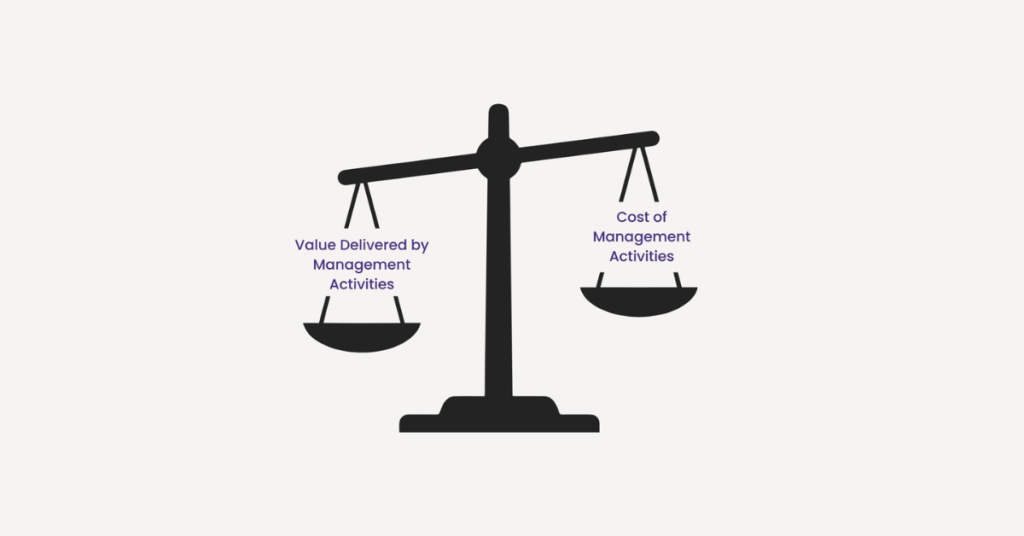
When we talk about improving project delivery, the conversation often centers on tools, templates, and methodology. But smarter project thinking begins with a more basic question: why does our organization manage projects in the first place?
The simplest answer is also the most important: we manage projects because doing so creates more value than if we didn’t. And that idea comes with powerful implications. If managing a project is meant to create more value than it consumes, then project leaders at every level must consistently ask: Is the effort I’m applying actually increasing clarity, alignment, and progress—or just adding noise?
This idea—that project management should deliver more value than it consumes—is the heart of what I call the Management Value Ratio (MVR). MVR is not a formula to calculate. It is a way of thinking. The Management Value Ratio reflects the relationship between the effort we use to manage work and the value that effort produces. When management effort creates clarity, alignment, coordination, and momentum, the ratio increases. When management effort creates complexity, slows work down, or introduces process that does not meaningfully reduce risk or improve flow, the ratio decreases.
In principle, the ratio is simple. In practice, measuring it precisely would be impractical. The work required to calculate the exact impact of management activities would likely exceed the benefit of knowing the number. But as a guiding mindset, it is incredibly powerful. It helps everyone involved in a project pause and ask: Is the effort I am applying creating value that is proportional to the time, attention, and energy it consumes?
To understand how value is created through management, it helps to look at the Crevay Project System, which recognizes that all project work can be viewed through six core activities:
- Setting project goals
- Defining how to reach the goal
- Monitoring progress
- Responding to change
- Doing the work
- Improving the system itself
These activities happen at every level of the organization, not only at the project management layer. Executives set the strategic outcomes that give the project purpose. Business leaders translate those outcomes into operational meaning. Project professionals facilitate clarity, coordination, and planning. Execution teams contribute insight from the ground, adjust workflow, and provide feedback. And at the end, everyone contributes to learning and improvement.
When we view project work through these six activities, the Management Value Ratio becomes easier to evaluate. We can ask:
- Are we setting goals with enough clarity that the team understands success the same way leadership understands it?
- Are we defining how to reach the goal with a level of planning that is appropriate to the complexity of the work, rather than defaulting to over-engineering or under-structuring?
- Are we monitoring progress in a way that drives decisions instead of just creating status reporting entries?
- Are we responding to change in a way that protects outcomes and people, rather than reacting from urgency?
- Are we doing the work in a way that removes friction instead of creating it?
- Are we learning from our work in a way that meaningfully improves the system next time?
These questions bring the ratio to life. They help us see whether management effort is increasing value or diminishing value.
The implications are significant. When leadership considers the Management Value Ratio, oversight is more purposeful. When project professionals consider it, they begin to choose actions that improve clarity, flow, and collaboration rather than adding structure by default. When execution teams consider it, they understand how their transparency, estimates, and feedback shape outcomes beyond their task lists.
When everyone in the system evaluates their decisions through the lens of value created relative to effort consumed, the entire project environment becomes more sustainable and more effective. Processes become lighter but still sharper. Communication becomes clearer. Meetings become shorter and more intentional. Decision-making becomes faster because the right information is there at the right time.
This is not about finding the perfect process. It is about developing a habit. A habit of asking whether the work we are doing is worth the effort it consumes. A habit of noticing where value is created and where it is lost. A habit of right-sizing management to match the complexity and stakes of the work, rather than defaulting to method for the sake of method.
The Management Value Ratio is a lens. Once you learn to see through it, the work looks different. You begin to recognize where project systems support good work and where they get in the way. You start making decisions that increase clarity instead of friction. And the organization benefits not because you are doing more work, but because you are doing the work that matters.