The Project Communications Gap: Four Capability Areas and How to Develop Them


1. The Paradox
A few years ago, I walked into a client meeting feeling completely prepared.
I was the new project manager on a small government contract — brought on, I’d been told, over the client’s initial reluctance. No matter. I’d done this kind of work before.
My first task was to help them reorganize their division’s internal team site. I had the assessment, the findings, the recommendations, all laid out in a polished deck, the kind of deliverable that signals: you’re in good hands. I know what I’m doing.
Things went off the rails from the word “go”.
The group challenged every finding. Questioned every recommendation. The distrust in the room was palpable.
Despite my humiliation and frustration (and the tell-tale red flush crossing my face) I did my best to listen and to stay focused.
At one point, the client picked up a pen and drew what they actually wanted on the back of one of my printed slides.
I rode the train home, wracking my brain: what had gone wrong? The analysis had been solid and the recommendations were sound. I’d done this same work a dozen times.
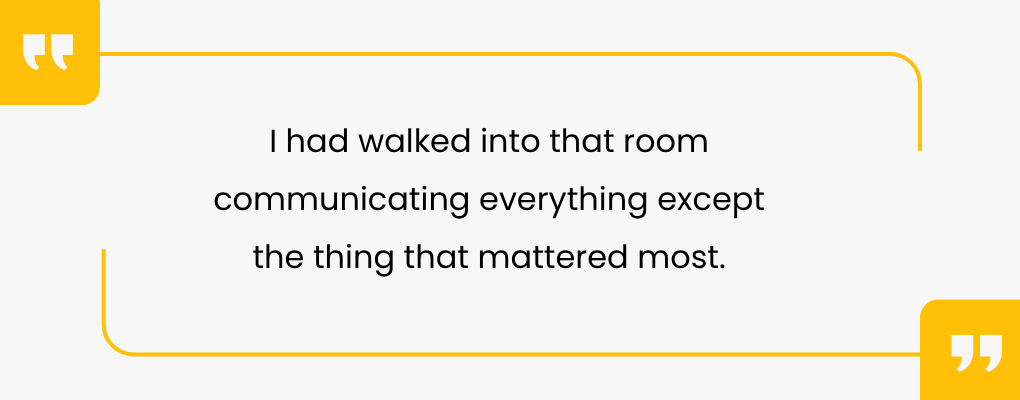
What I didn’t understand yet — and what no certification had prepared me to understand — was that I had walked into that room communicating everything except the thing that mattered most.
2. What the numbers tell us
That story is personal. But the problem it points to is structural.
Let’s look at the numbers:
A figure widely cited by the Project Management Institute tells us that project managers spend somewhere between 75% and 90% of their working time in some form of communication. Status updates, stakeholder meetings, difficult conversations with sponsors, negotiations over scope and resources, emails that have to be worded just right.
Communication isn’t a part of the job. It essentially is the job.
And yet when projects fail, poor communication is consistently among the leading causes. PMI’s research found that ineffective communication is the primary contributor to project failure one-third of the time, and a significant factor in more than half of all unsuccessful projects.
That gap is expensive. For every billion dollars spent on projects, an estimated $75 million is at risk specifically because of ineffective communication. Not technical failure. Not scope creep. Communication.
Independent research reinforces the picture. Wellingtone’s annual State of Project Management survey, drawing on practitioners across industries and geographies, found that project professionals now rank communication as the single most important skill for the profession’s future. Forty-four percent named it their top priority. That’s a clear signal from the field.
There’s a finding in the PMI data that I think is even more revealing than the failure statistics, though. When asked how much of their professional development time they spend on communication and related skills, project professionals reported spending 46% of their hours on technical skills — and less than a third on communication, leadership, and strategic thinking combined. The very capabilities the field says matter most are the ones practitioners invest in least.
That gap—between what the evidence says matters and where development time actually goes—isn’t just a data point. It’s a description of what it feels like to manage a project in most organizations. Capable, experienced people doing important work, with almost no structured support for developing the skill that takes up most of their day.
By 2023, PMI had elevated communication to what they now call a “power skill” — one of the core competencies that distinguishes high-performing project professionals. It’s a meaningful reframing. Renaming it, though, is not the same as developing it. The training hasn’t caught up with the label.
Most formal training still emphasizes communication planning, stakeholder registers, reporting cadence, escalation paths. These tools comprise the architecture of information flow, and they matter. They prevent chaos and reduce avoidable surprises.
What they do not automatically develop is the ability to read distrust in a room. To navigate resistance without becoming defensive. To signal credibility before authority has been granted. To influence upward when project success turns on the quality of the decisions handed down from leaders.
The data points tell us communication matters. Our experience tells us we’re still not talking about the right part of it.
3. What Your Training Actually Covered
Project management standards do address communication, but they address a specific slice of it.
Across PMI, PRINCE2, and Agile frameworks, communication is primarily treated as a management function. It’s something to plan, structure, distribute, and monitor. The underlying assumption is: if the right information reaches the right person at the right time in the right format, everything will be OK.
That model works if the barrier is what people know, how clearly they understand. However, clarity is often not the issue. It wasn’t the problem in my site design meeting. The slides were clear. The logic was clear. The recommendation was detailed.
The barrier was distrust.
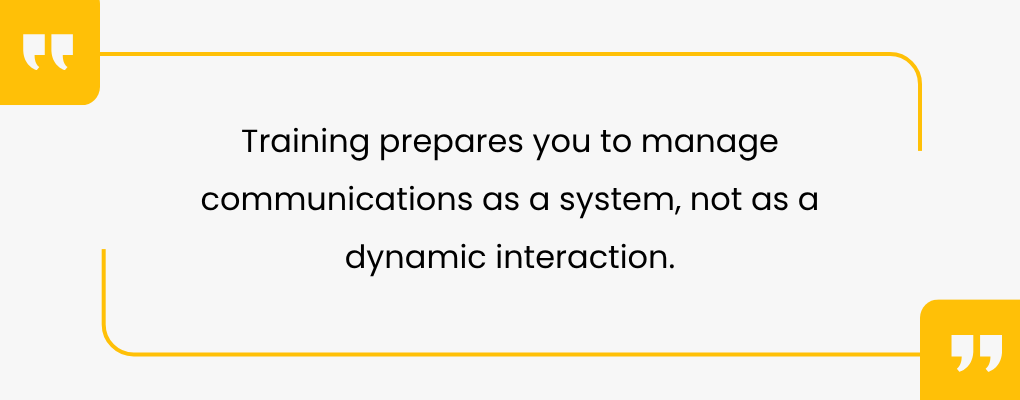
Most formal training prepares you to manage communications as a system. It does not fully prepare you to manage communication as a dynamic interaction shaped by identity, status, power, history and perception.
The standards do acknowledge this territory: active listening, political awareness, conflict management, and cultural awareness all appear in the PMBOK’s list of relevant skills.
But they appear as line items, not as developed capabilities. Each one is actually a constellation of skills, applied differently depending on your role, your organization, and what’s at stake. Naming them is not the same as building them.
There is also a dimension the frameworks miss almost entirely: communication demands escalate with experience and complexity. A coordinator keeping stakeholders informed and a senior PM navigating a resistant executive are not doing the same thing.
That is where the gap lives. Not in the planning tools, but in the human capability those tools assume you already have.
Understanding it requires a clearer picture of what PM communication actually involves. It isn’t one skill, or even one type of capability. It’s four.
4. Four Capability Areas of PM Communication
Think of PM communication not as a single skill but as four distinct capability areas — each drawing on different knowledge, different instincts, and different kinds of development.
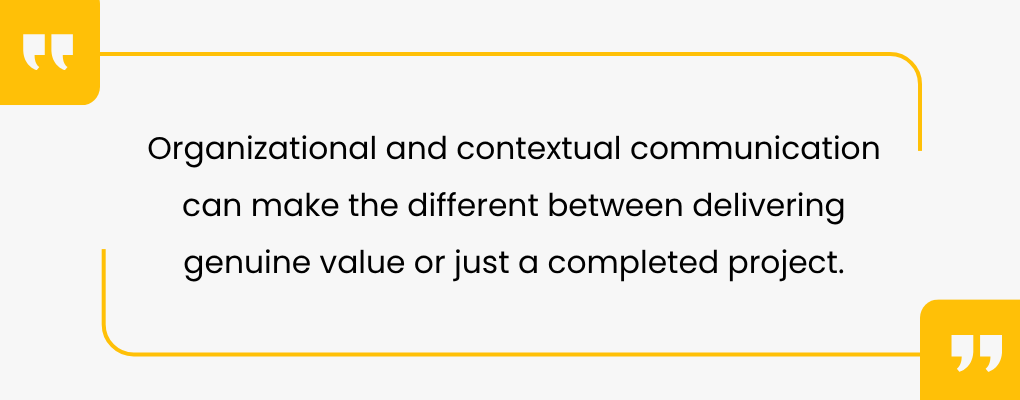
Most project managers are reasonably strong in the first. Many have significant gaps in the second. The third and fourth are rarely developed at all — not because PMs lack the capacity, but because most organizations never create the conditions for it, and never think to expect it. They are also the capability areas that determine whether a PM delivers genuine organizational value or just a completed project.
Capability Area 1: Logistical communication
This is the architecture of information flow. Who needs to know what, in what format, at what frequency. Status reports, escalation paths, stakeholder registers, meeting cadence, documentation standards.
It matters enormously. Without it, projects lose coherence. Decisions get made on stale information. Stakeholders are surprised by things they should have seen coming.
This is also the capability area that formal training covers best — and that most experienced PMs have developed reasonably well. The planning tools serve this area effectively. If you’ve been managing projects for several years, you likely know how to structure a stakeholder register and build a communications plan.
The limitation surfaces when the right people are receiving the right information and nothing is changing. When the status report is accurate but doesn’t create action. When escalation procedures exist but the culture makes it unsafe to use them. Logistics can’t fix what isn’t a logistics problem.
Capability Area 2: Relational and influence communication
This is where most project problems actually live — not in the plan, but in the room.
Relational communication is the human-to-human capability that determines whether people trust you, give you honest information, and follow your lead. It includes negotiating without formal authority, delivering difficult news without damaging the relationship, navigating resistance, and building the kind of credibility that has to be earned before a title confirms it.
This was the capability I was missing in that government meeting. The slides were fine. What I hadn’t done was establish the foundation of trust that would have made those recommendations land differently.
The standards acknowledge this territory. Active listening, political awareness, conflict management — they’re in the PMBOK. But listing a skill and developing it are different things. Relational communication isn’t learned from a framework. It develops through practice, honest reflection, and feedback in real situations — and it requires understanding your own patterns under pressure as much as it requires technique.
Capability Area 3: Organizational communication
As PMs gain experience, they encounter a category of communication that no methodology prepares them for: the informal systems that actually govern how decisions get made, resources get allocated, and careers get shaped.
Every organization has a formal structure and a real one. The real one is a landscape of relationships, influence, history, and competing priorities that determines what actually happens when a project needs something. Organizational communication is the ability to read that landscape and navigate it — to recognize who is genuinely invested in the project’s success, who is quietly resistant and why, and who holds influence that doesn’t appear on any org chart.
This capability area includes building relationships that have no immediate transactional purpose — the connections that create trust and goodwill before you need them. It includes making the value of the project, and of your work as a PM, visible and legible at the leadership levels where resource decisions and strategic commitments get made. It includes knowing how to advocate effectively — not just reporting status upward, but framing the project’s needs and progress in language that moves decision-makers toward the right decisions.
A PM without this capability can do excellent work and remain invisible. They can make the case for resources and be systematically overlooked — not because their argument is wrong, but because they haven’t built the organizational relationships and credibility that make arguments land. They may find that a project succeeds on its own terms while failing to produce the organizational recognition or career traction that the work deserved.
This is the capability area most PMs develop, if they develop it at all, through hard experience rather than deliberate practice. It is also one of the most learnable — with the right frameworks, honest peer feedback, and exposure to PMs who have navigated these dynamics successfully.
Capability Area 4: Contextual communication
This is the capability area that most directly determines whether a project delivers genuine value — and the one most conspicuously absent from PM training and organizational expectations alike.
Both PMI and Agile frameworks have moved in recent years toward emphasizing value delivery over process compliance. PMI’s current standards are explicitly organized around value. Agile has always prioritized working outcomes over documentation and procedure. This is the right direction.
But neither framework translates that orientation into specific communication capabilities. “Focus on value” is a principle. Knowing how to perceive and communicate the relationship between your project and the larger systems surrounding it is a skill — and a different one entirely.
Contextual communication is the ability to read the organizational and external environment, understand how it bears on what the project is doing, and communicate that relationship clearly to the people who need to understand it. It operates in both directions: inward, helping the project team understand what the organization and environment are asking of them; and outward, helping organizational leaders and stakeholders understand what the project reveals about where they are and where they’re headed.
In practice this looks like a PM who notices that a regulatory shift changes not just a project’s constraints but its purpose — and has the communication capability to make that case to a sponsor before the project spends six more months optimizing for the wrong outcome. Or a PM who recognizes that the organization’s strategic priorities have quietly shifted since the project was chartered, surfaces that disconnect, and facilitates the conversation about whether to adapt, redirect, or stop.
This is the difference between a PM who delivers what was asked and a PM who delivers what was needed. The first requires competence across the first three capability areas. The second requires contextual communication — the habit of looking outward, tracking the larger environment, and keeping the project connected to genuine value even as the world around it changes.
A coordinator keeping stakeholders informed and a senior PM navigating an organizational transformation are not operating in the same communication environment. The difference isn’t experience or seniority alone. It’s the development of these last two capability areas — the ones that connect project work to the organizational and environmental systems it exists within, and make the value of that work legible to the people who determine what happens next.
6. How to develop each capability area
Traditional PM training covers logistical communications reasonably well. The development gaps live in the other three — and closing them requires different approaches than earning a credential.
Area 1. Logistical communication
If your fundamentals are weak, standards-based courses and certifications serve you here. The PMBOK, PRINCE2, and Agile certifications all develop this capability area deliberately, and the investment is worthwhile early in a PM career.
Most experienced PMs, though, already have adequate logistical capability. The more useful investment is auditing what you already do. Review a recent communications plan or stakeholder register with a critical eye: where did information flow break down, and why? Look at a project that surprised its stakeholders — what was missing from the system that should have been there? That kind of retrospective analysis will surface more actionable development than another course.
Area 2. Relational and influence communication
This capability area can be studied, but study alone won’t develop it. It requires deliberate practice in real interactions, honest reflection on what happened, and feedback from people who will tell you the truth.
The component skills worth developing deliberately include:
Persuasive communication — understanding how people form beliefs and make decisions, and how to construct arguments that resonate with different audiences. This goes beyond logic: credibility, emotional resonance, and timing all determine whether a well-reasoned case actually moves people.
Negotiation — learning to identify interests beneath stated positions, create options that serve multiple parties, and reach agreements that hold. Project managers negotiate constantly — over scope, resources, timelines, and priorities — often without recognizing it as negotiation or having a principled approach to it.
Navigating resistance and organizational change — understanding why people resist change, what drives different forms of resistance, and how to respond in ways that reduce opposition rather than harden it. This is distinct from persuasion: resistance is often not about the argument. It’s about identity, loss, trust, and history.
Active listening and inquiry — developing the ability to listen for what isn’t being said, ask questions that open rather than close conversations, and create the conditions in which people tell you what they actually think. This is a learnable skill that most professionals significantly underestimate.
Conflict navigation — distinguishing between conflicts that need resolution and tensions that need to be held, and developing the range to handle both without defaulting to avoidance or escalation.
Frameworks and books give you conceptual grounding in each of these areas and are worth reading. But the development happens in practice: the difficult conversation you’ve been avoiding, the negotiation where you have no formal leverage, the resistant stakeholder whose position you haven’t yet tried to genuinely understand. Seek those situations out deliberately. Debrief them honestly, ideally with a peer or mentor who observed what you couldn’t see about yourself.
Area 3. Organizational communication
This capability area develops primarily through exposure and relationship — which means it’s harder to develop in isolation and harder to accelerate through formal study.
Seek opportunities that put you in contact with organizational levels and functions beyond your immediate project environment. Cross-functional assignments, even informal ones, build the peripheral awareness that organizational communication requires. If your organization has senior leaders who are accessible, find legitimate reasons to be in the room — not to perform, but to observe how decisions actually get made and what language moves people at that level.
Build relationships before you need them. The PM who has invested in connections across the organization — with peers in other departments, with leaders in adjacent functions, with people who understand the informal power dynamics — has a fundamentally different set of options when a project needs something than the PM who hasn’t. This isn’t networking in the transactional sense. It’s the slow accumulation of mutual understanding and goodwill that makes organizations actually work.
If your current organization offers limited access to these experiences — and many do, particularly smaller or lower-maturity organizations — professional communities of experienced PMs become especially valuable. Peers who are navigating similar organizational terrain, in different industries and contexts, can provide both the perspective and the honest feedback that isolated practitioners rarely get. This kind of gap in professional development is part of what drove the development of communities like the Radical Projects Collective in the first place.
Area 4. Contextual communication
This capability area begins with a habit of mind before it becomes a communication skill: the habit of looking outward.
Develop a practice of environmental scanning — reading broadly about your industry, your organization’s strategic direction, and the external pressures bearing on your projects. This doesn’t require hours of research. It requires the deliberate intention to connect what’s happening in the larger environment to what your project is doing, and to ask regularly whether that connection still holds.
The communication skill develops from there. Practice translating what you observe into language your stakeholders can act on. Start with low-stakes observations: a market shift that might affect a project assumption, an organizational priority that seems to be evolving, a constraint that may be more negotiable than it appears. Raise them in project conversations. Notice what lands and what doesn’t, and refine your ability to frame context in terms of decisions rather than information.
At a more advanced level, develop the ability to facilitate the conversations that need to happen when context changes — when a project’s original rationale has been overtaken by events, when the right answer is to adapt or stop rather than to deliver. These conversations require all four capability areas working together: the logistical clarity to present the situation accurately, the relational skill to navigate the emotional and political dimensions, the organizational awareness to understand what’s at stake for the people in the room, and the contextual grounding to articulate what the environment is actually asking for.
7. Where to start
Four capability areas. Dozens of component skills. A lifetime of practice ahead.
If that feels overwhelming, it should — briefly. Then let it go.
The point of this framework isn’t to hand you a development plan that covers everything. It’s to give you a clearer picture of where you actually are, so you can make a more deliberate choice about where to go next.
Start by locating yourself honestly. Which capability area is your strongest? Which one, if you’re truthful with yourself, is the place where projects have gone sideways, opportunities have been missed, or good work has gone unrecognized? That’s probably where the most useful development is waiting.
Then choose one thing. Not a curriculum. Not a certification. One skill, one situation, one conversation you’ve been avoiding, one relationship you’ve been neglecting to build. Do it with intention. Pay attention to what happens. Adjust based on what you learn. Then choose the next thing.
This is how capable professionals develop in the areas that matter most — through the accumulation of small, deliberate experiments that build on each other over time. The PMs who communicate most effectively aren’t the ones who accumulate the most credentials or studied the hardest. They’re the ones who kept paying attention, kept adjusting and working to figure it out.
If you’d like to work on these capabilities alongside other experienced project professionals who are navigating the same terrain, the Radical Projects Collective is a free community built for exactly that. You’ll find peers who understand what it’s like to do this work in organizations that don’t always make it easy — and who are serious about getting better at it. You can join at [link].
It isn’t a credential. It’s a practice.